

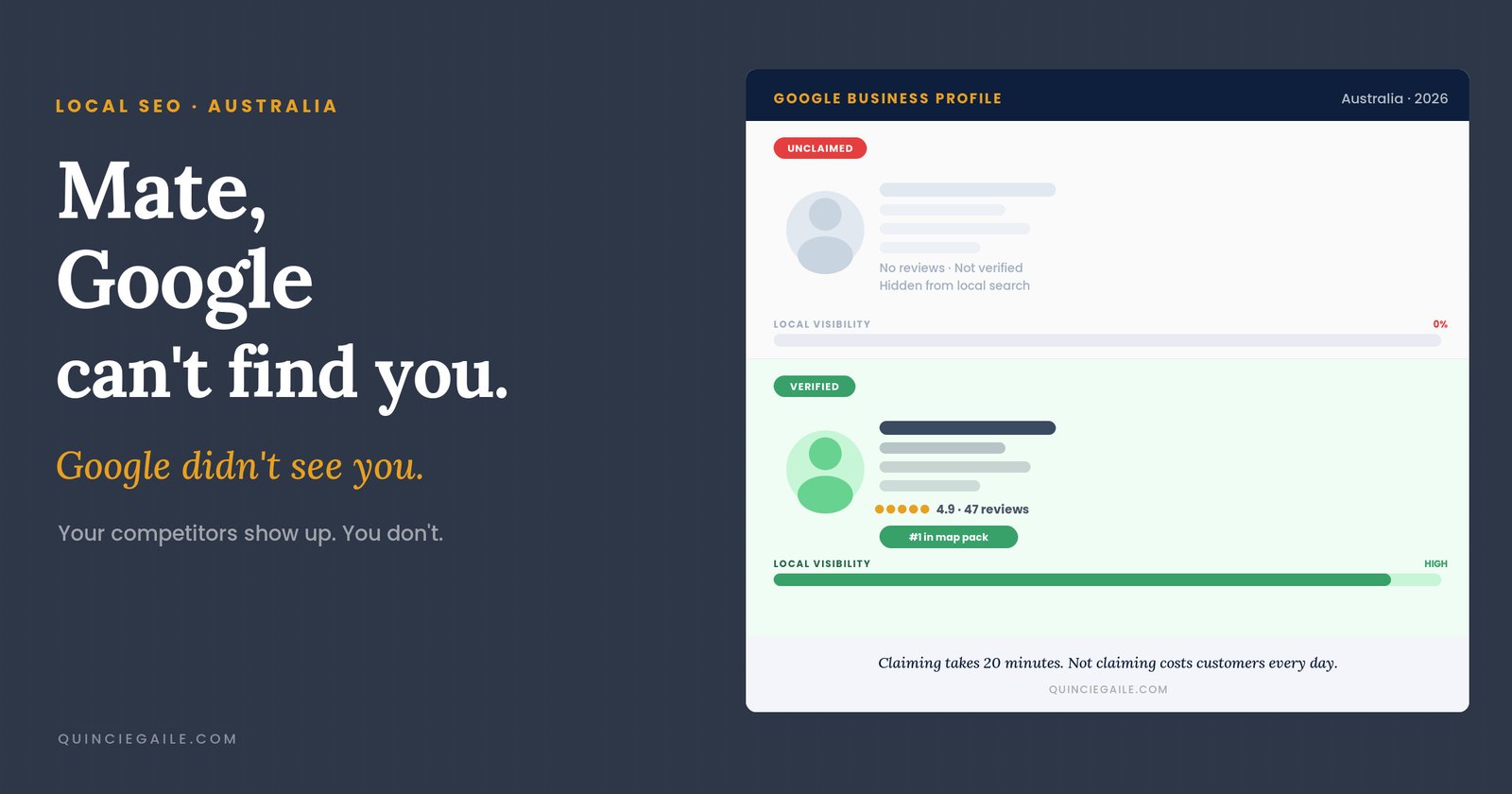
Mate, Google can’t find you
I’ve worked with a client who’d been operating for years – solid reputation, good word-of-mouth, a real business. They’d rebranded – new name, new direction, fresh energy. The old name was everywhere though. Search the business and the previous brand still dominated the results. The new name barely registered.
That’s a specific kind of invisible. It’s not that the business doesn’t exist online. It’s that Google still thinks it’s someone else. In local SEO Australia terms, it’s the most avoidable kind of invisible.
I worked on redirecting that – making sure whenever someone searched the old name, the new brand was what came up. Consistent signals across the profile, the site, the directory listings. Slowly, the new name started to own the space the old one had built.
The thing is, none of it would have mattered if the fundamentals weren’t in place first. And for a lot of Australian businesses, the fundamentals aren’t. The name might be right. The local SEO Australia side of things might not be.
Your Google Business Profile is not optional
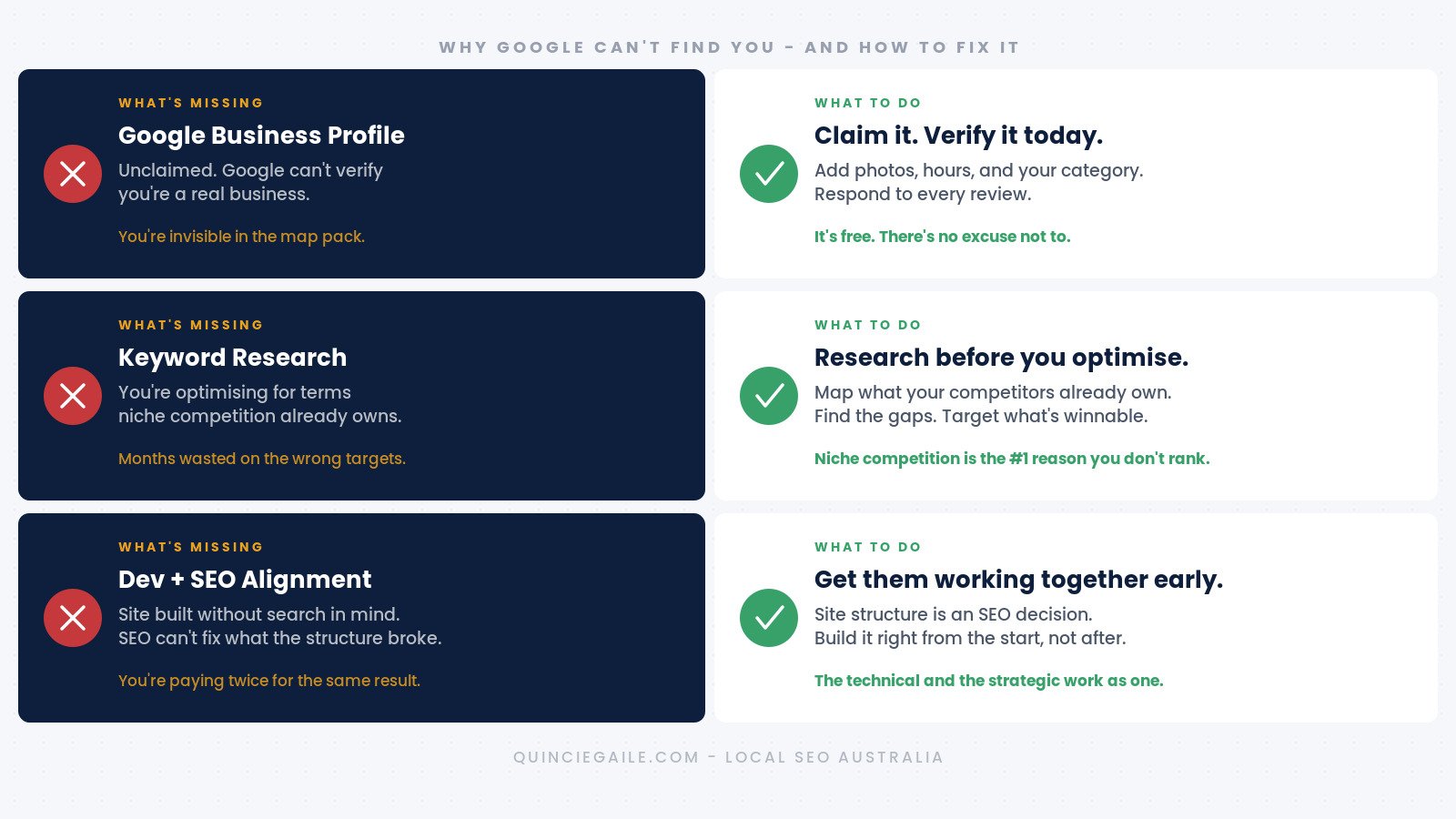
Before anything else – before keyword research, before content, before any conversation about backlinks – claim and verify your Google Business Profile.
GBP is how Google confirms you’re a real business at a real location. It feeds the map pack results. The “near me” searches. The little panel that shows your hours, your reviews, your photos when someone looks you up directly. It is free, it takes a couple of hours to set up properly, and not having it is the most avoidable reason a local business doesn’t appear in search.
Once it’s verified, keep it active. Add photos. Respond to reviews – all of them, including the ones you’d rather ignore. Update your hours when they change. Google pays attention to whether a profile is maintained or abandoned, and so do the people reading it.
A profile that was claimed in 2022 and never touched again is not working for you. It’s just sitting there.
Research before you start optimising
Here’s a reason businesses don’t rank that has nothing to do with anything they’ve done wrong: they’re trying to rank for terms they can’t compete for.
Niche competition is real. Some industries – legal, finance, trades in dense metro areas – are dominated by national directories, large franchises, and well-funded sites that have been building authority for years. You can compete locally. But you need to know what you’re walking into before you start, not after you’ve spent six months optimising for the wrong things.
Good keyword research shows you where the actual gaps are. Which local terms have real search volume. Which ones are owned by players you can’t outrank from your current position. Which specific phrases – the ones your actual customers are typing – are sitting there without serious competition.
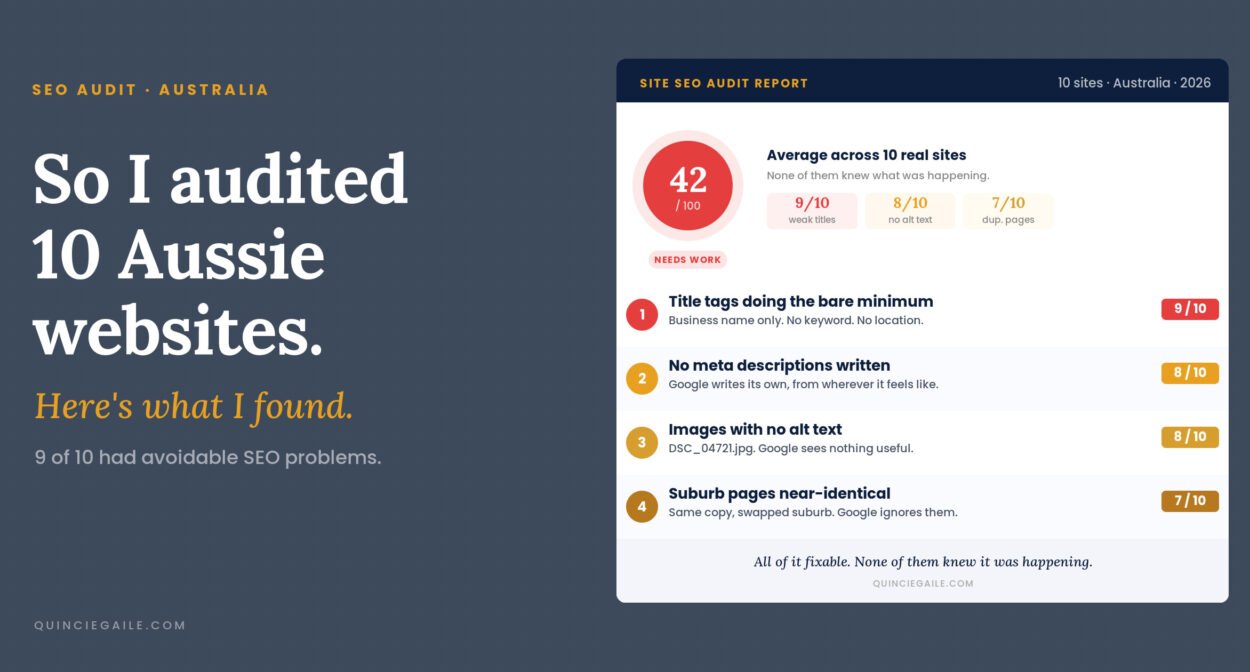
When I audited 10 Australian websites, one of the most consistent problems wasn’t technical. It was businesses chasing broad, competitive terms while leaving the specific local phrases that were genuinely winnable sitting untouched. They were optimising hard, just for the wrong targets.
For local SEO Australia: research first, optimise second. In that order, every time.
Hire people who already know the job
A good SEO expert doesn’t need to be educated on the basics. They’ve seen the problems before. They know the audit checklist, the technical flags, the content gaps, the on-page fundamentals. You’re bringing them in to apply that knowledge to your situation – not to figure it out at your expense.
When you’re evaluating someone, skip the credentials and ask for specifics. What industries have they worked in? What did they actually change, and what happened to traffic after? If the answers are vague or packed with jargon and short on results, keep looking.
The same applies to the web developer you’re working with. Someone who understands how SEO and site structure interact is worth significantly more than someone who doesn’t – because the technical foundation of the site directly affects what SEO can achieve on top of it.
Your developer and your SEO person need to talk
This is where a lot of businesses waste money they don’t realise they’re wasting.
They commission a website. Months later – sometimes years later – they bring in someone to handle SEO. The two parties have never spoken. The result is a site that looks fine, loads slowly, has structural issues the SEO person has to work around, and takes twice as long to produce results because the base wasn’t set up with search in mind.
Site speed, crawlability, URL structure, schema, mobile performance – these aren’t SEO bolt-ons. They’re built into how a site is constructed. When your developer understands what search requires, and your SEO person can communicate those requirements clearly, both sides of the work reinforce each other. Things move faster. Changes stick.
When they operate in separate lanes, you’re paying full price for half the result.
You can’t afford to get local SEO Australia wrong
If a customer searches for what you do in your area and you don’t show up, they call someone who does. They don’t know you exist. They have no reason to find out.
That’s the real cost of getting local SEO wrong – not a drop in traffic, but opportunities that went to someone else while you weren’t watching.
The gap between invisible and visible in local SEO Australia is usually smaller than it looks. A verified profile, the right keyword targets, a well-built site, the right people working together on it. None of it is complicated. It just has to be done properly.
If you’re not sure where your business sits, that’s exactly what I help work out.
Add a review
Your email address will not be published. Required fields are marked *